Saturday, February 20, 2010

The Awakening, the Vigil, the Dream

Nightfall
The dreams form a linear pattern like the coils of a rattlesnake
Each flowing into the next
Seamlessly
So seamlessly

I await the dénouement
Passive, powerless, pondering
But the secret unravels when it so fancies
And promptly sinks back into its lucid wakeful obscurity
The oneiric detective wakes and shakes his fists in frustration
The damned solution has slipped his grasp once again
Ain't that just always the case

Pathetically he rises and stares at the moon
His accusatory glare is understandably ignored
The moon and the night must have bigger fish to fry
Tending to insomniacs and whores and dark alley dwellers
Handing out gifts of poetic inspiration and pneumonia
Usually not upon request


The City
Is what he always dreamed of
Seventy stories of nothing separate him from the ground
Jagged spikes protrude from the earth and scrape the clouds
And inside their metallic shells the last workaholics of the day drag themselves away
To families that don't exist.

High up the wind swirls and rocks the tower
The pillar of modernity

But his vision is that of old yellowed photographs and noir classics
And melancholic nighttime diners and fedoras and shots of whisky
And soft saxophones and pianos
And creases in the face

Unable to solve the mystery that haunts him
He revisits old dreams
And the glass is his accomplice
His listener his consolation his silent obedient counselor
His partner in crime

As the City

Looms.


16/02/2010

Bahram Alivandi


Simorgh (The Conference of Birds)


Ferdowsi and His Mythos

Boris Dubrov


9.02.2010: Why Felines, Lactose and Faucets Are the Same Thing

The 9th is a perfect way to commemorate the 7th, because after all, it’s its 2/365th anniversary. Sadly, I seem to have permanent and terminal memory loss in all things related to the 7th, which was essentially a day spent at home trying to figure out how express myself in a way that, in view of coherence being an unreachable ideal, would at least get some kind of message across. With varying results: the idiot savant within me came up with the Farsi equivalent for “We don’t have lions in Poland,” which incidentally is said and written exactly the same as “We don’t have milk in Poland”, as well as “We don’t have taps in Poland” (Maa dar Lehistan shihr-ha na daarim). I hasten to add that we do indeed have milk in Poland, and the only taps we don’t have are the ones that are likely to play at the next American colonel’s funeral.

Just to fill in the massive wave of passionate readers, in Faro, I’m staying at a friend’s mother’s house, and the only line of communication can be established in Farsi, a language in whose case the entirety of my previous knowledge could be brought down to “one, two, three” and the five expressions Javid hastily wrote down on a piece of paper.

No doubt about it, though: the core, the marrow of the day was definitely the dinner, attended by quite a few people, namely Behrooz’s mom, his brother Mohammad, Nina, Somayeh, Atefeh, Javid, Mosab and a girl from Turkey named Tuba who I hadn’t known before, quite possibly because she arrived two weeks ago. Aside from bits and pieces of my brilliance that shone through such complicated phrases I learned as I am 20 years old, I was notable for being that kid on the sidelines who can but cast furlong glances while everyone else speaks Farsi and Turkish.


Seeing as part of my lifestyle transformation program is paying attention to culture and cuisine, this is also the time to discourage or encourage readers by naming some of the foodstuffs present. Unfortunately, I can name just one: āsh, a thickish soup typical of Iranian cuisine whose main ingredients are almost entirely composed of vegetables and herbs (Aunt Wiki speaks of legumes, onions, meat, parsley, spinach, dill and a host of other delicacies). Another curio was what seems to be called nargesi esfanaaj – fried spinach with eggs and onions. Since Iranian cuisine is heavily based on rice and pasta, both of them were in abundance of course.


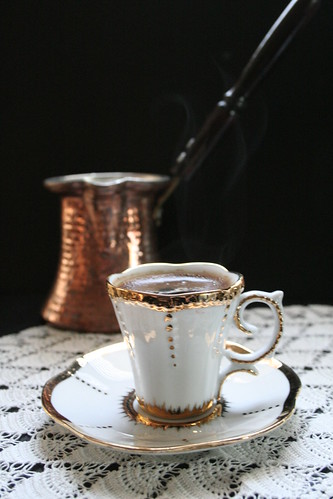
But cultural enrichment didn’t stop there, and as Tuba made the Turkish coffee, I learned that Turkish coffee is a method, not a variety, and since a step-by-step guide to the method is readily available everywhere on the Web, I’ll spare myself the anguish of trying to explain. I was the odd man out when Tuba did some tasseography; Javid, Somayeh, Ati and Mosab had their fortunes told instead. I believe some more of my inglorious attempts at Farsi followed, but that with that, the evening concluded. Next time I see Tuba, I’ll ask her to do a quick reading; hopefully the dregs will read “JUMPSTART”. Preferrably in Farsi.

7.02.2010: A Crash Course in Farsi and Other Pleasures

7.02.2010

Sleep deprivation for three days has an immediate effect on your karma. Comes around faster than anything. I won’t even begin to try to calculate the hours I have and haven’t slept; in any case, aside from the 12-hour morphean marathon last night, I don’t think it was more than, say, eight. Within the space of three days. I’m so overwhelmed with yesterday in particular that this entry is not gonna be much more than a string of sentences lest I forget. I draw inspiration from Kerouac and his “automated writing”, “spontaneous prose”, “free-association technique”, whatever floats your boat. The difference being that Kerouac was a writer and I’m far from it. And, as far as I can see, he didn’t spontaneously go off on a tangent like I’m about to do right now.


I’ve always envied fast readers. Trudging through a book’s introduction during a three-and-a-half-hour train ride and not getting any farther is a pain in the ass, especially when you get the feeling that it harmonically complements a general slowness of the mind. This last one I still feel sometimes (the worst days are thankfully over), especially when I’m in an unfamiliar or embarrassing situation, or in a new place. I’d sell my soul an my abundant collection of useless trinkets to Lucifer if it meant an increased ability to adapt. Mine’s not the worst, but at times I still feel it is. Regardless, an additional 14 or so hours nodding off and nodding on at the airport – and in flight – produced a whopping 94 pages of On the Road. Hard to get immersed in a book if you keep going back to how slow you’re doing it. Rereading whole sentences and passages drives me up the wall precisely because I do it constantly, and I do it constantly for two reasons. On one pale horse rideth Concentration (or rather, He doth not ride since he’s left the building) and on the other rideth Imagination (who once again also dismounts and gets the hell out of Dodge a lot). I make conscious efforts to imagine what I’m reading, with results varying wildly. The most difficult part being geographical locations, spatial projections, descriptions of places. Seems my spatial intelligence is sub-zero. Another thing about On the Road is that the journey encompasses cities I know nothing about, and in some cases never heard of. And the narration isn’t the sort of disorganized mess I expected. No free-form stream of consciousness here, like chaotic thoughts in Stephen King. In any case, I’ll finish it before I leave.

Here’s my attempt at chronology. In the wee hours of the 5th, I left for Poznań to meet up with Maurycy, who greeted me after I arrived at the station and took me around town to see some of the important things. Quite an inspiring city, I must say, now that I tend to compare anything and everything with Lublin. At his place (in a suburban neighborhood) I met and ate dinner with his mom, his dad and his sister, and had the pleasure of meeting his dog, Heban. As great a guy as ever (Maurycy, not his dog, though he takes after his master, no doubt). Maurycy drove me over to the airport and off I went, I in the sky. Additional mission to carry out: buy tremoço for Maurycy and stuff it into my coat pocket. Stansted was its old admirable self, though strangely enough, the hordes sleeping on the floor were much smaller than usually. Between perusing On the Road and intermittently dozing off, I chugged down half a liter of energy drink and promptly fell asleep once again.

Faro. Lo and behold, I had to wait over an hour for the bus, which also seemed to perplex an Asian girl that was there with me. The long and heavenly wait interrupted by the coming of the bus, I got out near the bus station and gave Nina and Behrooz a call each from the Jardim da Alagoa. An hour or so later, my feet felt like oversized chicks in eggs of rubber as I dragged on in search of Nina’s place, which turned out to be some 30 steps away from where I first called her. Once there, I met an Iranian couple working at a store in town for the last 20-odd years and pumped myself full of pastéis de nata. The couple seemed extremely knowledgeable in diverse areas, and showed me such wonders of nature as sugar cubes made from beetroot (brought from Iran) and a spice they said was called cardomman, whose spelling I have to check and which was used in the tea Nina made. Overstaying my welcome, I watched Nina cut Atefeh’s hair, Ati being a girl living here with Javid, and met Rita and Gui, respectively an Italian Economics intern and a Portuguese guy living with Nina and Rita. My welcome was additionally overstayed by dinner (including vinegar-drenched lemon) and I made a prompt exit to get to Behrooz’s mom’s place. A wonderful lady. Javid had written several basic phrases for me beforehand and I’ve never lived with someone I can’t possibly communicate with, but I foresee situations of exceeding hilarity to come of this. It’s a unique feeling, really: I feel like a newborn, complete with all the innocent and helpless naïveté that is an integral part of learning a new language. So, secondary objective: learn some Farsi, even some basic conversational stuff. It ain’t gonna be easy. But in the night, on my way back from Behrooz’s place and with a sleeping bag and sheet under my arm, it occurred to me that was exactly what I loved when I took up Spanish and Portuguese: the newness, the freshness and the amazing realization that I no longer have the linguistic and communicational aptitude of a macaque.

Last-minute reflection: Javid told me how he’s working with a couple of people on a project connecting engineering with medicine, and the purpose is developing a ultrasonographic system similar to the scanning methods used during pregnancy, but this time for purposes like identifying and treating cancer, obliterating the x-ray and other techniques of ambiguous usefulness and win-some-lose-some properties. I see that as revolutionary. I see that as something that makes a change and makes a difference. However you spin it, it’s a difference I’m not making as of today and which I’d like to make as of tomorrow.

Of Carnivals and Libraries: A 10-Day Memoir

Throughout the next few days I'll transfer some of what I jotted down in Faro to Quixotica. Sadly enough, the captain's-log routine of picturing each day eventually provoked a cease-and-desist action on my part, but I have the essence imprinted in my memory like a branding iron in the hide. It's not Faro I'll miss for the next days and weeks and months; on the last night, I used every trick in the book to stay at Nina's place and avoid saying the last khoda hafez. My parting words (not counting the ones uttered mere minutes later when I hurried back for my forgotten notebook) were "Piroozi baraaye enghelabe sabz ("Victory for the Green Revolution") and I indeed hope for it. What it would be to contribute to a milestone like that. Beats the hell out of the blah of everyday life, which, however you spin it, is generally mundane. Your hectic life on three majors means nothing if you end up leaving no mark on the world around you. Howgh!

Here we go, without further ado, it is absolutely essential that we hand the mic over to this past half of February.

Sunday, January 31, 2010

Ensaio Time: As Eurecas dos Anos Zero

Inspirado pelo Exmo. Senhor LM, reproduzo cá em baixo um ensaio escrito com fins educativos e dedicado a todos os zero leitores que acumulei até agora.

***

E assim despedimo-nos, à grande e à francesa, dos primeiros anos do milénio. Agora é que está na hora, com os ecos da farra ainda a retumbarem nos ouvidos, de reflectir sobre todos os bens que as divindades e o incansável progresso humano nos conferiram durante os últimos 3650 dias (ignorando por preguiça os anos bissextos). Alguns dos nossos desventurados leitores até precisam de um bocado de animação para tornar mais alegre a aplicação de emplastros e terapias intravenosas nos olhos e mãos perdidos por um foguete na passagem de ano. A vida sem um órgão ou extremidade essencial é uma maçada, mas não desesperem! Os avanços da ciência e da medicina já permitem toda a classe de milagres, como bem podem afirmar as mulheres de silicone que não deixam de ter muita procura no mundinho da moda. Mas como são raros os leitores que estejam à procura da melhor forma de recuperar os apêndices e ao mesmo tempo de aumentar o tamanho dos seios, deixemo-nos já destas coisas tristes e passemos ao que é o tema deste pequeno comentário: a inovação no nosso século XXI.


Eu digo: os primeiros anos do século foram uma bênção para o mundo no que às novas tecnologias diz respeito. Mas as imagens do mundo via satélite, as compras na Internet com entrega ao domicílio de tudo desde os móveis da casa até à galinha para o caldo (morta já, pois a gente orgulhosa da cidade não vai sujar a mãozinha com esta porcaria de degolar o seu jantar), o primeiro coração artificial que funciona e os implantes de retina que tornam a vista possível para os cegos, o mapeamento do genoma humano, epá, todos eles não passam de pequenezes de segunda quando comparados com o que realmente revolucionou o dia-a-dia no século XXI. Talvez não conseguíssemos obliterar a fome no mundo ou achar uma terapia efectiva no combate ao SIDA (além de ter o bom senso de confraternizar com a camisinha). Mas com o fim de resgatar esta década da infâmia, eu cá proponho a seguinte amostra dos objectos e conceitos que mudaram o mundo em que vivemos.


Começamos sem grande estardalhaço, com algo que agrada a todos, aquela mais descarada perda de tempo de sempre que se chama o videojogo. Ressalto que o futuro pertence às crianças de hoje, preparadas com esmero para aturarem qualquer desgosto na vida real, que não lhes há-de parecer tão temível depois de ter aguentado corajosamente o banho de sangue no seu First-Person Shooter ultra-realista. Sim senhor. É também nesta década que floresceram algumas das ideias mais geniais no campo dos videojogos: é notável esta revolução ter começado com uma simulação completa da vida, desde o nascimento até à morte. Aquele jogo, The Sims, deixou inútil a grande chatice da vida não-digital e acabou por ser uma válvula de escape para os que não tinham sido agraciados com o prazer de possuir uma personalidade. Mas isto grande novidade não é. Os miúdos de hoje em dia têm mais hipóteses para se entreter. Graças ao Wii, a consola que esmagou os concorrentes, podem fingir praticar desporto fazendo trejeitos epilépticos com o telecomando na mão. Ou até podem fingir tocar a guitarra como uma estrela de rock, sem sequer sair de casa, com um daqueles guitarrões de plástico com teclas em vez de cordas. Reverenciam aqueles aparelhos por serem muito propícios para o seu look de rebeldes. A tecnologia permitiu-lhes serem os senhores do porão de papá, onde tocam gozando com a sua irreverência, quebrada só às vezes para devorar o jantarzinho trazido por mamã.


Grandes progressos fizeram-se também no transporte público. Eu lembro-me da euforia doida que me suscitaram os primeiros – e únicos – patins em linha de nova geração que me presentearam os meus pais. Na verdade eram uns ténis com solas que pesavam uma tonelada porque havia umas rodas lá dentro. O efeito era semelhante ao que devem sentir os mafiosos quando Dom Fulano Corleone decide que sobram e manda-os tomar um banho ao pé do cais com dois blocos de cimento a segurar as pernas. Mas no momento de armar aquele trem de aterragem, apesar dos desconfortos, tudo valia o olhar invejoso dos gajos do bairro. Ora, estes mesmos gajos do bairro cresceram, saíram da asa da galinha e foram dos primeiros snobes que correram em debandada quando apareceu o Segway. Conhecem o Segway? Não conhecem, aposto. Se não conhecem, será pela mesma razão que não conhecem os ténis com rodas: aquilo dá vergonha. A ideia era de vender milhões destes veículos de mobilidade urbana que em 2001 haviam de fazer tremer o mercado dos automóveis tradicionais. Predizia-se uma venda aos milhões. Venderam-se 30,000. É capaz de ser porque um senhor a deslocar-se numa destas maravilhas se parece muito com Papa-Léguas. E pior ainda se vai de gravata, fato e casacão a agitar-se no vento. Pelo jeito, ninguém gostava de ser Batman.

Ninguém duvida, porém, que o Segway foi um grande passo adiante no meio dos polícias, que deslizam silenciosos pelos espaços abertos dos supermercados a plantar as sementes do terror nos corações dos ladrões. Mas a máquina só acertou num nicho bastante reduzido. Uma outra novidade que sim desencadeou uma revolução social do caramba: as sandalias Crocs. A sua inovação consiste, por ordem de importância, em serem tamancos de plástico, em ferirem os olhos do espectador que os contempla, em causarem hilaridade durante qualquer evento público, em parecerem (pelo que dizem, que eu não o vejo) dentes de crocodilo e em os originais custarem um dinheirão. Mas eu até pagava um dinheirão para ficar com um bom cacareco de plástico, e ainda mais se se trata duma das grandes invenções do século, conquanto fosse um dos poucos a desafiarem a moda. Mas nos pés de milhões de pessoas, os Crocs terminam por ressaltar um importante problema social: revela a extraordinária estupidez das massas.


Mas enfim, esta pequena amostra é só a ponta do icebergue. A abundância das inovações úteis concebidas nos últimos anos parece não ter fim: é inquestionável a utilidade do capacete de protecção com bandejinhas laterais para encaixar duas latas com palhinhas para sorver um bocado de refrigerante enquanto se faz outra coisa. São igualmente incontestáveis os benefícios sanitários do taco de golfe propositadamente oco para servir de latrina de emergência quando um golfista tem a súbita necessidade de fazer xixi. Aliás, foi também só neste século que se inventou o sanduíche de 1,500 calorias capaz de dar um infarto relâmpago a quem o contemplar, o que pode ser de grande utilidade para controlar a população mundial. Enfim, é verdade que esta importante tradição de excelência que se criou nos anos zero promete-nos mundos e fundos. Mas considerado este deslumbrante progresso em que nos encontramos, é certo que vai dar para ir muito longe.